
6.3 Equivalent Propositions - From "The Reasonable Person" by Mark Grannis
Equivalent Propositions
"...propositions that differ in form but not in matter, and which must always carry the same truth value."


- Quantity and quality may change --->>> Truth value of the statement must remain the same.
Conversion
"the kind of equivalence that results when we reverse the subject and predicate of our original proposition without making any other change."
- "if one is true, then both are true, and if one is false, then both are false."
HOW - To do conversion just swap subject and predicate.
WHEN - Only can do it for E and I propositions (and partially A)
- "these are the only propositions in which subjects and predicates have the same distribution."
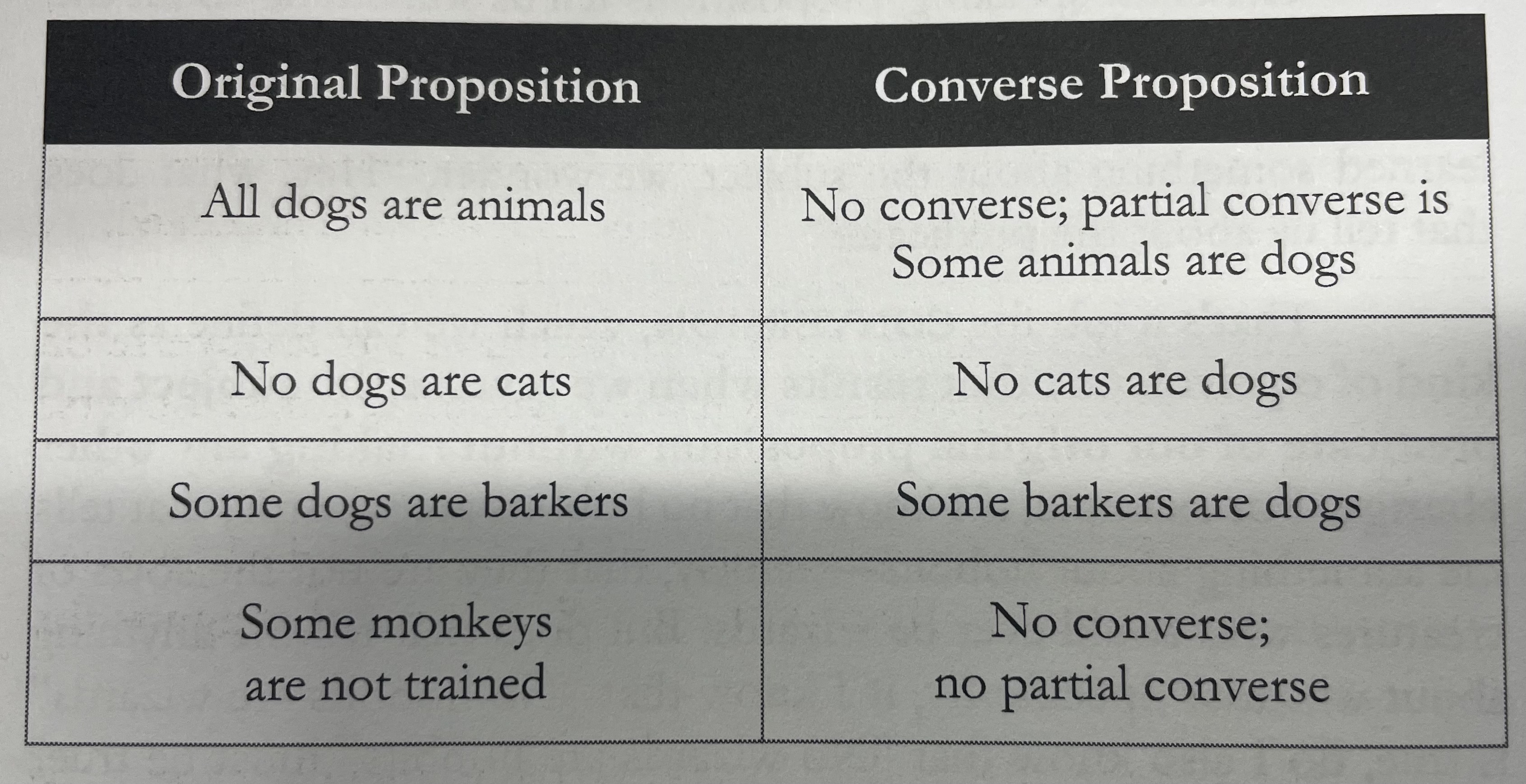
Any true proposition on the left will be true on the right. False on the left, then false on the right.
Obversion
"Obversion is the kind of equivalence that results when we change the quality of our original proposition and negate the predicate."
HOW - First, swap the predicate for a negated version of the predicate. Then change the quality to match (horizontally across the square)
- "first, change the quality; second, negate the predicate."
- To negate the predicate add a "non- or un-" to the predicate.
WHEN - All propositions can be obverted. "we can always obvert".

Any true proposition on the left will be true on the right. False on the left, then false on the right.
Contraposition
"Contraposition is the kind of equivalence that results when we obvert the original proposition, then convert the resulting obverse, then obvert again."
HOW - Negate both subject and predicate. Then swap them.
WHEN - "only A and O propositions have contrapositives."

Any true proposition on the left will be true on the right. False on the left, then false on the right.
Study Questions


Comments
Post a Comment